Blog Archives
THE GOODBYE PROJECT: Letting Go is Good, Yo! Episode 5–The National Geographics
About The Goodbye Project:
There are so many of us who can’t part with objects because of the sentimental attachment we have to them. You know—the graduation tassels, the barfed-on stuffed animal with the missing eye, the coat your late father bought for you because you begged. So what do you do when it’s time to let go of these beloved items because it’s absolutely necessary?
I’d read someplace that one of the best ways to let go of an object is to know that you have a photo. Sure, you can photograph it before you get rid of it. The Goodbye Project takes the idea a step further: go back and find photos of yourself actually with, using, or wearing that object, and blurb a bit about the memories it invokes.
Why? Everything has a story.
And because of that, the object deserves more than just a hasty trip to the Goodwill or the trash without a second thought.
EPISODE 5: OH, NATGEO!
Every Christmas, my Dad got a National Geographic gift subscription from his mother, so a closet in my childhood home museumed NG’s dating to the early 1950s.
When a new journal arrived, it was relegated to the back of the toilet—but each was a passport to new and exciting passions: sharks, volcanoes, highways I’d never traveled (somewhere in my basement there is a photo of me at age four sitting on the toilet “reading” the National Geographic). In some cases, the articles I loved most were compasses for major life decisions: where I went to college, what I was going to be when I grew up, how to process and survive injustices done to me by others.
Dad kept close watch on his inventory, but over the years, I’d absconded with a few of my favorites. These are the five I have left.
I decided I can let go of three. Oh, and by the way, if you are as big a fan of National Geographic as I am, yes, National Geographic is on Facebook! You can find them here: http://www.facebook.com/NGM

You can see how many of Dad’s issues I had here on this shot of my bookshelf in 1993.
VOL. 159, NO. 1: JANUARY 1981

Sunday, May 18, 1980:Mt.St. Helens erupted. The family was packing up for church and then my grandmother’s house. I don’t think we heard the news until later, and then I was upset I wasn’t home alone with the television. To make up for it, Dad let me stay home from school on Monday. This was before the days of 24-hour coverage, so to have news on all day, or even on-and-off during television programming, was a huge deal. I was nine when the mountain blew, but its story made me a regular 5 or 6 o’clock news watcher—at least for awhile.
Eventually, reporting on the event taxied to a halt. I was desperate to explore further, but there wasn’t much material available (for those of you who are younger, there was a time when no one had Internet and there weren’t such things as Amazon when you could get books on anything you wanted—you were restricted to whatever was on the shelf at Bradlee’s or Caldor). So when this issue arrived a few months later I was thrilled. At last, I was going to get the inside scoop.


I couldn’t stop studying this dead bird—I imagined its death throes. See the little bird’s footprints? It struggled to breathe before it keeled over. Even after I put this magazine away, I never forgot the photo of this bird and the impact it had on me…

…and it’s probably why, to this day, whenever I see a dead bird I photograph it. Here’s one in the Bronx Zoo parking lot, Bronx, New York, July 24, 2004.

This vista—before and after—was like watching a train wreck. I couldn’t believe how something so lush and green could turn into a moonscape in minutes. This would become one of the reasons, though, that my favorite piece in Disney’s Fantasia 2000 is “Firebird Suite,” which relies heavily on the Mt. St. Helens eruption for its inspiration.

A photo of Mt. St. Helens taken by an ex-boyfriend of mine as he flew over it back in 1999. He was, in all honesty, a selfish person who rarely considered anything beyond his own comfort, so I was surprised he’d even thought to do this for me. It created a bond between us for a little while, but still wasn’t enough to save the relationship—no shock there. Who’d expect that a photo of an explosive volcano would make a great totem for anything? I was dumb enough to try—at that time, the way to my heart was still through science.
At the time, our babysitter was Dawn Nagle. She bought me an oil lamp crafted fromMt.St. Helensash. To this day it is one of my most treasured possessions, and I still light it once in awhile.
Here’s an excellent website which looks back at the Pulitzer Prize-winning coverage provided by The Longview Daily News (out ofLongview,Washington, which isn’t too far from the mountain).
http://www.tdn.com/app/helens/

The article following the extensive Mt. St. Helens piece, “Pompeii of Prehistoric Animals in Nebraska,” mapped a moment in time ten million years ago in which animals were engulfed in volcanic ash as they romped about in their water hole: “Death comes with agony in a rain of volcanic dust, causing the animals to suffocate.” This image captivated my imagination. Did they understand what was happening to them?
VOL. 1, NO. 5: MAY 1984

I remember the day this came in the mail; I was 13. I slid off the brown-bag cover (remember those?) and the sight of this terrified me. Then I saw “The Dead Do Tell Tales at Vesuvius.” I’m not even sure if I knew anything about Vesuvius at the time, but as you’ll discover in future episodes, volcanoes fascinated me. It never made it to the back of the toilet or the archives.
Before I read the text of “The Dead Do Tell Tales at Vesuvius,” I studied the photos and their captions. I recall being very disturbed by one photo of an empty cradle; from its caption: “Blow on a dead man’s embers and a live flame will start.” The thought, expressed by poet Robert Graves, holds true for Herculaneum…Fragile, too, was the life of a baby whose skeleton was found in the charred crib (right), rocking today as it did 1,900 years ago.”

The photo of the cradle that disturbed me. Although I’ll admit I was disappointed the bones weren’t in it.
At the time, my heroes were scientists: marine biologists, geologists, or volcanologists. I wanted to grow up to be one of those, but hadn’t decided yet. The first scientist depicted in the article wasUniversityofRhode Islandvolcanologist Haraldur Sigurdsson.

Haraldur was immediately added to my list of heroes.
After I came across his photo I read the whole article to learn more about what he had to say.

I was enthralled with the idea that it was possible to lay out an actual timeline just from looking at the layers of dirt. At that age, I’d never heard of such a thing.
Wow, I thought, I would sure love to take a class with that guy. I will definitely apply to go to school there.
Sure enough, in 1989 I did. Those of you who know me know that I embarked on my higher education at URI.
Years later—in 1998—I completed my first novel (it was terrible and it will never see the light of day, have no fear). It was a ghost story (of sorts) and was, perhaps, the first time I ever flirted with applying Poe’s triggers and the nature of haunting. I needed ghosts—but I wanted ghosts of a specific nature.
I wanted a common element among the ghosts—they needed to be burned, specifically, in their physical lives. I already knew I’d wanted to use Pompeii, and so I started digging through my massive Pompeii collection (more on that in a future episode) and read just about every book, but couldn’t get this article out of my head, because of its connection to where I eventually went to college and the book’s setting. I re-read it, and it became the map for a whole plot thread.

This is the paragraph that inspired one of the major plot threads in my 1998 novel.

This paragraph played a major role in one chapter’s dialogue.

This is the face of a toppled statue in Herculaneum’s theater—it was imprinted in the volcanic flow. This face became the face of one of the ghosts in my 1998 novel.
Now, I’d said the book will never see the light of day. And I meant it. But just for fun, here is the chapter that was inspired by the article. It’s a PDF. (Hey Dan Pearlman and Jerry Rivard—I cannot believe I used to be this “as-you-know-Bob.” Enjoy.)
VOL. 162, NO. 6: DECEMBER 1982

This one comes second in the sequence because it was the May 1984 issue which led me to it—“The Dead Do Tell Tales at Vesuvius” made reference to “Buried Roman Town Gives Up Its Dead.” I descended to Dad’s archives and pulled it out.


I was forever highlighting information—mostly facts I wanted to remember—but the first line I highlighted on this page because of its forlorn quality. It brought a desperate image to mind.

That so many people died at Herculaneum was a shock to scholars, since before this, hardly any remains had been found.

I remember I couldn’t stop looking at this picture. It horrified me. Imagine, like the man in the forefront, diving head-long into hot ash and knowing you aren’t going to get up. Ever.
This article would also serve as fodder for the 1998 novel, but when I was reading it back when I was 13, I kept envisioning piles of people huddled in the boat bays. According to the story, they were instantly incinerated. The thought of that haunted me for weeks.
KEEPERS
VOL. 133, NO. 2: FEBRUARY 1968

The cover that kicked off my obsession with sharks.
I was 11 when I found this one in Dad’s collection, and the shark was so mean-looking I was sold—that old principle of being fascinated by things that we fear. I was done—sharks were the new love of my life. The copy I have isn’t my father’s original; it’s one I bought about 15 years ago at a tag sale. The original I cut up so I could tape the pictures all over the walls of my secret under-bunk-bed hideout (I am SO GLAD my father did NOT find out about that).
Years later, I was watching the movie Jaws, and there is a scene in which Roy Scheider is flipping through a book about sharks. Many of the photos from this article are in that book.

Anything about sharks—articles, photos, whatever I could find—I shoved into this notebook.


Here’s an example of the stuff I did in my spare time. I’m sure I traced this from some photo I found, because I couldn’t free-draw any better back then than I do now.

From left, my brother Chuck, my sister Missie, and me in the stream that ran through our five-acre property up in Salisbury, New York, in the Adirondack State Park. Each of the rocks had names. I am standing on my pet Great White Shark, “Cream Cheese.” Missie is standing on my pet Lemon Shark, “Crackers.” These sharks were the method of transportation for the character that represented me in my Underwater University series of stories, which were inspired by all of the science books I was reading and were about scientists of all kinds living in an underwater station similar to the one in the Battle of the Planets cartoon series. The character that was “me” in these stories was the Senior Ichthyologist. There were 26 stories; sadly, I only have 24, 25, and 26. I have no idea what happened to the first 23.
VOL. 182, NO. 6: DECEMBER 1992

Obviously, I took this one because it had an article on volcanoes I wanted to read. I got the surprise of my life when I discovered that “The Hard Ride of Route 93” was much more interesting.
I was home from URI for Christmas weekend, mostly because I needed to recover from a really screwed up pseudo-relationship with a person who basically had no relationship skills—I was confused by all the head games this person played, and really had no way to process it, let alone forgive it. Christmas weekend that year was a much-needed respite around normal people.
Enter the article “The Hard Ride of Route 93.” The characters who lived and traversed that desolate highway in Nevadawere romantic, intense, damaged, and off—just like the person I’d been dealing with. I read the article several times, took the issue back to Rhode Island with me, holed up between December 27 and 30 (yes, it only took me four days) and wrote the play Stranded on 93, which was produced at URI in April of 1993.
By the time it was all over, I hadn’t forgiven the person—but at least I could understand the problem wasn’t mine and could move on (and something tells me that person hasn’t changed at all, because people like that usually don’t).
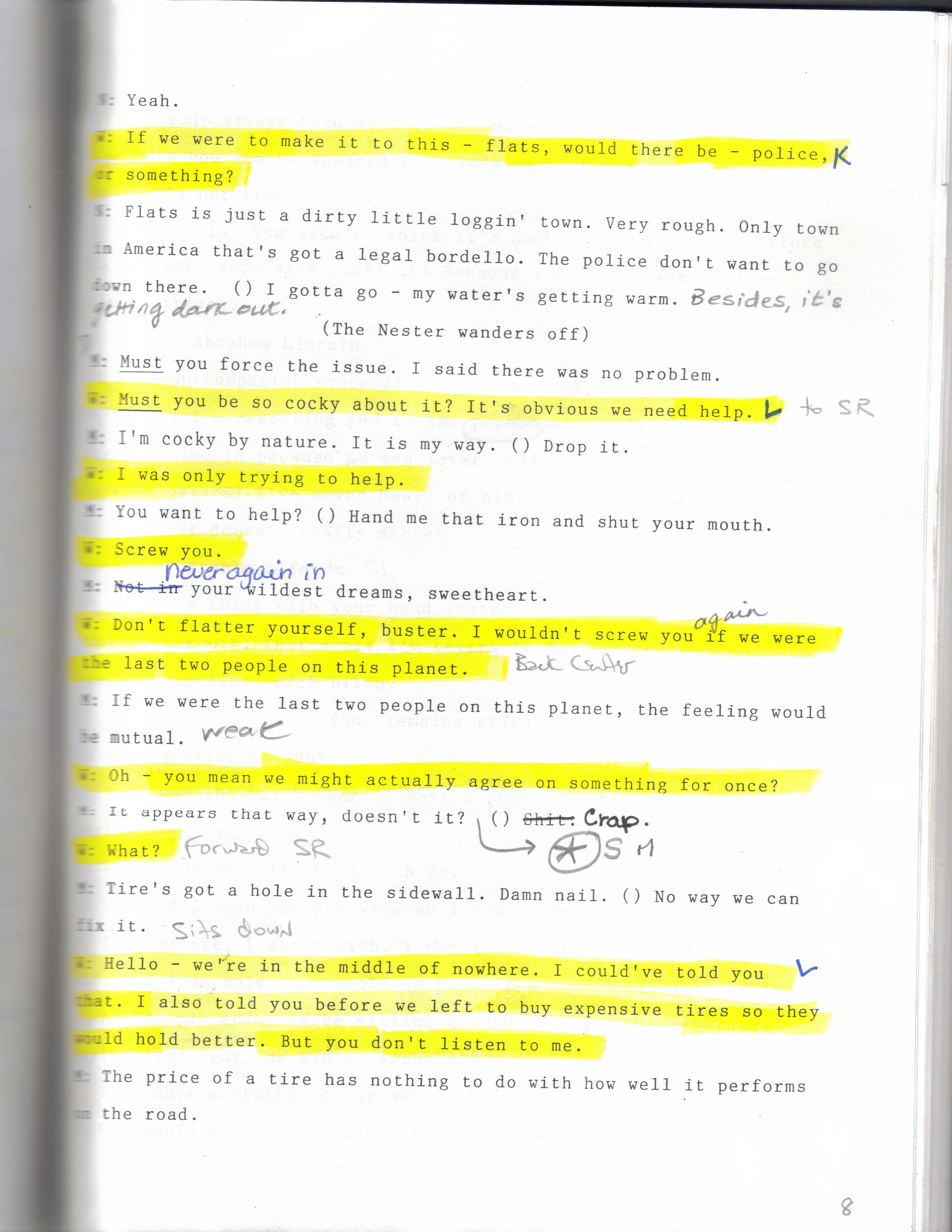
A page of the Stranded on 93 script.

The press release for Stranded on 93.
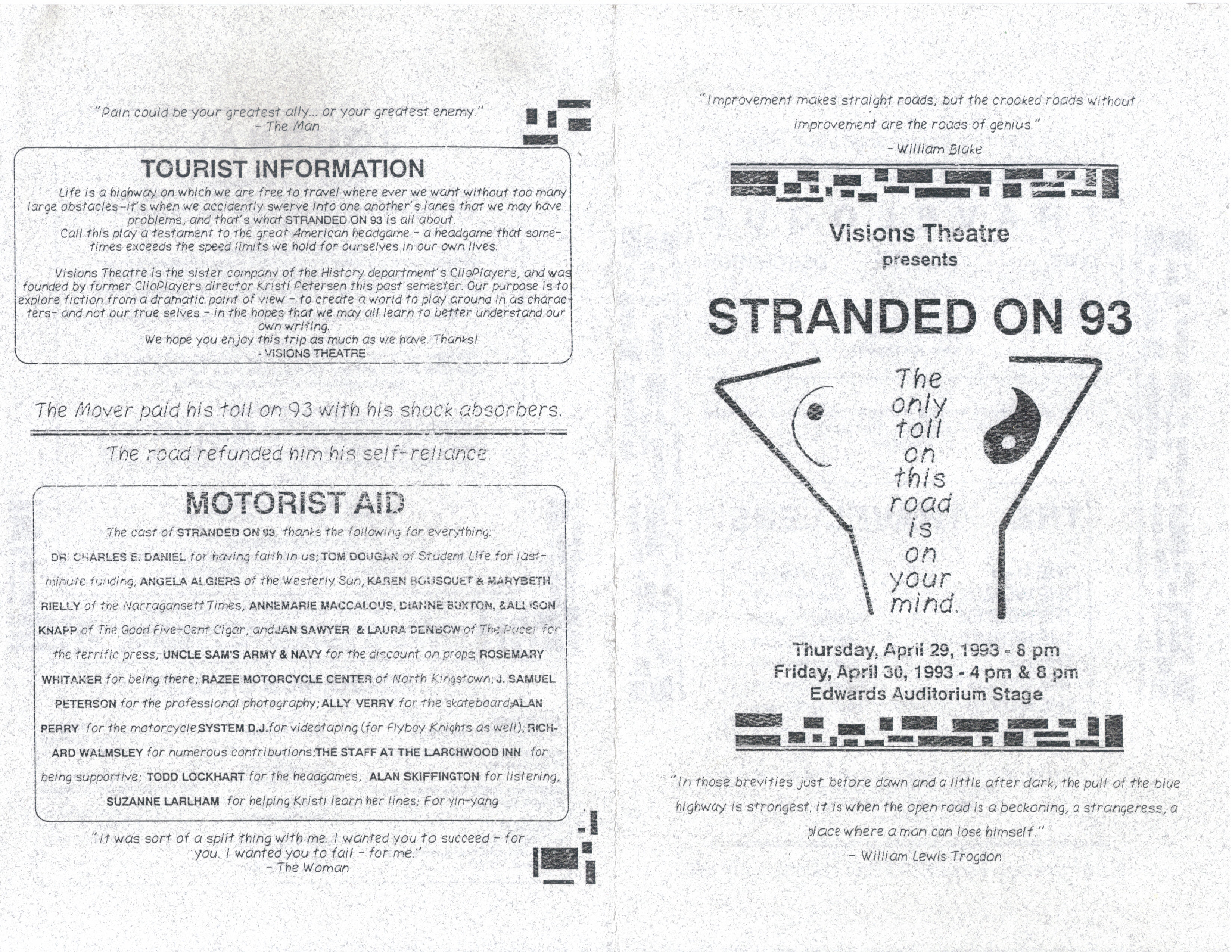
Pages four and one of the program.
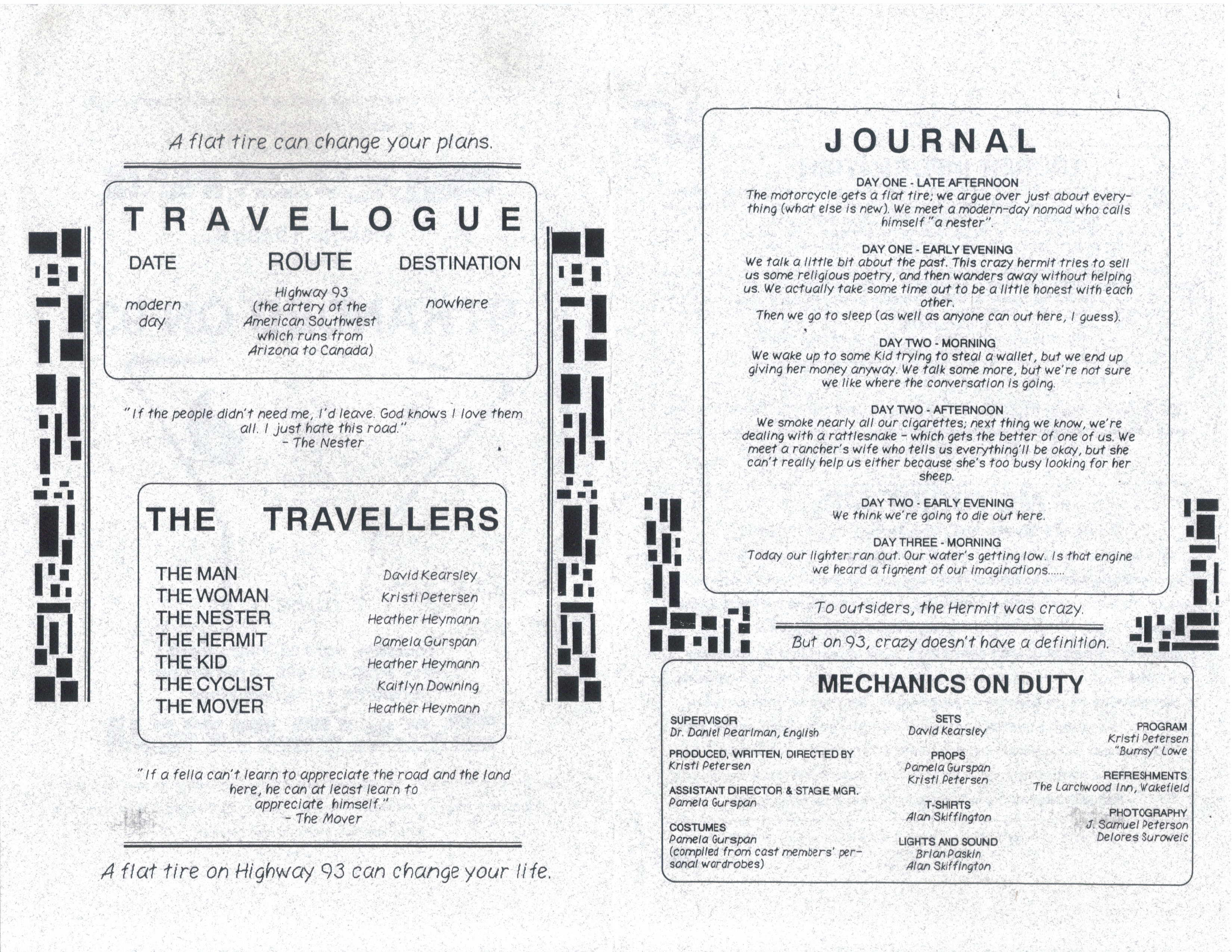
Pages two and three of the program.

The Cast of Stranded on 93 poses on my old 1986 Mustang at an abandoned gas station on Route 2 in Rhode Island, March, 1993.
So what am I doing with the three that I’m letting go? Well, I’m committing a sin: I’m ripping out the cover and the significant article. The two articles on Pompeii will go into the one Pompeii book I kept. The one on Mt. Saint Helens will go into my childhood save box (I’m allowing myself one tub of special keepsakes).
As for the other two, I can say I will never leave those behind.
THE GOODBYE PROJECT: Letting Go is Good, Yo! Episode 4–The Nancy Drew Collection
About The Goodbye Project:
There are so many of us who can’t part with objects because of the sentimental attachment we have to them. You know—the graduation tassels, the barfed-on stuffed animal with the missing eye, the coat your late father bought for you because you begged. So what do you do when it’s time to let go of these beloved items because it’s absolutely necessary?
I’d read someplace that one of the best ways to let go of an object is to know that you have a photo. Sure, you can photograph it before you get rid of it. The Goodbye Project takes the idea a step further: go back and find photos of yourself actually with, using, or wearing that object, and blurb a bit about the memories it invokes.
Why? Everything has a story.
And because of that, the object deserves more than just a hasty trip to the Goodwill or the trash without a second thought.
EPISODE 4: NANCY DREW
As a kid, I was a great escapist. I had two favorite methods: reading, and role-playing as my favorite television heroine or hero.

These are the kids in my friend Kristen Hansen’s neighborhood, which was within walking distance of my house through the woods. We weren’t playing Nancy Drew that day, I’m sure, but probably Dr. Who. Role playing was big in that neighborhood; we were all pretty creative. I’d have to guess this was taken in the early 1980s.
Nancy Drew was an exception: she was the only heroine of mine from books that I imitated (apparently frequently; Bill Buckbee recalls our entire third grade year recesses with me as Nancy Drew and he and Kevin Fuller as Frank and Joe Hardy). I’d get a new book and rip through it in less than a day or so most of the time.

My friend Sonja in my room, 1985 (she’s holding a cassette! Remember those?) If you look behind her and toward the left, you can see a small collection of Nancy Drew books on the shelf.

My friend Samantha Levin used to have awesome birthday parties—but hers was a winter birthday (in March), like mine (in February), so her parents always had to be creative. This book was the one I was reading when she had a pool party at the Danbury Y. Then we all went back to her house and had pizza.
One birthday, in fact—1981, the most magical birthday I ever had, because I got the Battlestar Galactica game and not one, but TWO Nancy Drew books—my parents were angry because two days later I asked them if we could buy another Nancy Drew book.

One of the books I got for my birthday in 1981. I read it that weekend, but have always associated it with going to my friend Carrie Geren’s house during a blizzard—Dad took me over in the truck—and watching Ice Station Zebra on Channel 11 that same weekend.
“Your father and I just bought you two,” my mother said.
“I finished them.”
She turned and looked at me. “Kristin Mary, you did not. You just opened those.”
“I did too, I’m a fast reader,” I repeated.
“Well.” She shrugged. “Read them again.”
Ah! A woman who didn’t understand anything about flaming passion. “Mom, you can’t read them again right away. There’s no surprise.”
“Too bad,” she said. “They’re expensive.”
Expensive. Bradlees and Caldor had them for $1.99.

This is the other book I got for my 10th birthday. I remember staying up all night to finish it, because it comforted me during a terrifying experience. I had, that afternoon, watched a movie called The Devil at Four O’Clock—I loved volcano movies. Unfortunately, the white bulb in the nightlight had fritzed that day, and Mom and Dad replaced it with a red Christmas bulb. I was too afraid to close my eyes that night because of visions of lava pouring into my room.
But you didn’t argue with Mom. And that’s how, at 10 years old, I discovered the shelves in my father’s den.
I read things entirely inappropriate for my age: Irving Wallace’s The Word, in which I learned that if you failed at your career you became an alcoholic and slept with lots of people in far away cities; Jaws, in which I got a clue about what goes into grass and gazpacho soup, how married people have affairs (it’s usually with someone from your past and you have to do it in shitty motels and shower after so you don’t smell like sex, whatever THAT meant), and erections. I remember wondering if my parents had ever smoked grass, or if they’d ever had affairs. I remember feeling really uncomfortable and kind of dirty after I’d read it. I was haunted by the sentence: “Ellen started to giggle again, imagining the sight of Hooper lying by the side of the road, stiff as a flagpole, and herself lying next to him, her dress bunched up around her waist and her vagina yawing open, glistening wet, for the world to see.” (That’s on page 170 of my Dad’s copy, which was from Bantam Books’ 18th printing, June, 1975).
I finally was able to get another Nancy Drew book a few weeks later, but found I couldn’t respect her. I was suddenly aware that she and Ned should be having a full-on sexual relationship instead of this namby-pamby flirting thing, that at their ages they should at least smoke a cigarette or two and drink beer, and that she should get pissed off at someone at least once in awhile and preferably use a curse word.

I associate this with hanging out at my friend Kristina Hals’ house.
And so, for lack of $1.99 two days after my birthday in 1981, Nancy Drew was buried under a pile of adult books: Catch 22, Ghost Boat, The Bermuda Triangle, The Ghost of Flight 401, All the President’s Men, The Anthrax Mutation, The Amityville Horror—whatever crappy paperbacks my Dad had laying around. I read them so fast he never even knew they were missing before they were back on the shelf.
But I kept my original Drew collection, took them wherever I went. Over the years, I’d let go of one or two that didn’t have any specific memory attached to them. Eventually, I got down to my last seven, because they were the ones that invoke a special time or place.
Today, I let six of them go.

I couldn’t put this one down, and so I sat in school and had it open in the storage area of my desk so I could keep going throughout the day. I never got caught. I was good at clandestine reading.
The only one I kept was my first, The Secret of the Old Clock. And that’s just because my parents wrote “To Kristi, Love Mom & Dad, 12/25/79” in the front cover.
They had no idea what they were getting me into, I’m sure.
The books will be donated to a library sale.

Actually, all I remember about this one was that it scared the crap out of me, and there was something in it about acid being sprayed on their suitcases. “They bought new suitcases and went from store to store filling them” was the sentence that opened the next chapter. (Persistence of memory, folks, I’m not sure if that incident was even in this book because I read so many, but for some reason, I associate that with this cover, so there you go). In addition, the skate’s “face” really freaked me out.

We loved the TV Show in our house, too. This book I got at a tag sale, so it really doesn’t have any special memory for me other than that my brother Chuck and I couldn’t wait to watch it every week.

A history book I got for Christmas one year. Totally fascinating and a must-read for any Drew fan!
If you’re a Nancy Drew fan, there is a LIVELY Facebook fan page called Nancy Drew!! here: http://www.facebook.com/pages/Nancy-Drew/363747038826?sk=wall
…oh, and if you want to know who my other childhood heroines/heroes were, here’s the list:
1. Princess (from Battle of the Planets)
2. H.M. Murdock (from The A-Team)
3. Kaye Morgan (senior biologist, Jaws 3)
4. Ellen Brody (Jaws)
5. Maid Marian (Robin Hood — the Disney cartoon version first; later, the Costner flick)
6. Lady J (from G.I. Joe)
7. Amy Allen (“AAA” from The A-team)
8. DeeDee McCall (from Hunter)
9. Penelope Pitstop
10. Nancy Drew
11. Daphne (from the original Scooby Doo cartoon series)
12. Lisa (from the original Robotech, Series 1)
13. Jennette (from Treme)
14. Dana Scully (from The X-Files)
15. April (from Teenage Mutant Ninja Turtles)
THE GOODBYE PROJECT: Letting Go is Good, Yo! Episode 3–The Jurassic Park Stuff
About The Goodbye Project:
There are so many of us who can’t part with objects because of the sentimental attachment we have to them. You know—the graduation tassels, the barfed-on stuffed animal with the missing eye, the coat your late father bought for you because you begged. So what do you do when it’s time to let go of these beloved items because it’s absolutely necessary?
I’d read someplace that one of the best ways to let go of an object is to know that you have a photo. Sure, you can photograph it before you get rid of it. The Goodbye Project takes the idea a step further: go back and find photos of yourself actually with, using, or wearing that object, and blurb a bit about the memories it invokes.
Why? Everything has a story.
And because of that, the object deserves more than just a hasty trip to the Goodwill or the trash without a second thought.
EPISODE 3: JURASSIC PARK

I just love it when the camera captures something genuine. This is the moment in the Dinosaur attraction at Disney's Animal Kingdom Park in which the Carnosaur gets right in your face. In case you're wondering, that's me, left, freaking out. Nathan, on the other hand, looks like he's just made a new friend.
Like most kids, I had a thing for dinosaurs (I will confess here that I really wasn’t much into dolls). A few of my most exciting childhood memories: visiting the Museum of Natural History—I was very young, and it was the first time I saw real fossils. I remember being awed by the T-Rex skeleton’s mammoth proportions. The Geology Class field trip to dig fossils Freshman year in high school. I didn’t find any whole trilobites, but I found a leaf impression or two! A visit to the Peabody Museum—I got lucky and was there when Dolf Seilacher was giving a presentation on his exhibit Fossil Art. I was so fascinated I even got him to sign my copy of the book, in which I’d scribbled tons of notes (if you’d like more information on this, visit here: http://www.uv.es/pe/1999_1/books/fossil.htm)

Then there was the first time I visited Epcot’s Universe of Energy. When the curtains pulled back to reveal a prehistoric swamp teeming with breathing dinosaurs, I was so excited I wept. (Years later, I went on Dinosaur, and that wasn’t nearly as cool—I was too terrified to enjoy it. See it on my face in the above picture?) And let’s not forget the tons of fossil shark teeth I’ve picked up over the years.
And then along came Jurassic Park. And Jurassic Park: The Lost World. (By the way, before I go further: if you are a Jurassic Park fan and want to meet with like minds, I found a great community online at http://www.jplegacy.org.)
Being an ardent fan of Crighton anyway, I read The Lost World and was thrilled with some of the imaginative dinos I was expecting to see in the film (how about those ones that can change their skin color to match their surroundings? I was so petrified I had nightmares). When the movie came out in 1997, it was a big deal for me—and being the movie buff I am, the colorful promotional materials available were too tempting not to purchase—I’d just moved into Charles’ house and had loads of space (we even got our hands on a POP display Borders used for the release of the VHS).

Not the greatest shot of those stand-ups--I know there are better ones out there -- but you can see them on the upper left and right corners of the photo. Look closely! By the way, this photo was taken in 2002.
I was moving things around in the basement and unearthed a black box I’d forgotten about. The label on it read, “Jurassic Park.”

The storage box for my Jurassic Park: The Lost World collection.
I was surprised by the box, but more surprised by what was in it:

One of those giant soda cups. I think I might have gotten this for a few extra bucks at the movie theatre when the film premiered--in fact, I saw The Lost World at The Campus Theatre in Selinsgrove, PA, just after my brother Chuck graduated from Bucknell University. Check out The Campus Theatre here: http://www.campustheatre.org/index.html

At left, my brother Chuck, May 24, 1997, at his graduation from Bucknell University. That night, I headed out to the Campus Theatre in nearby Selinsgrove to see The Lost World.

No, I don’t have the Viewmaster or reels for this—honestly, I don’t know why I have the box, except that I suspect I might have given this as a present to my niece Andi and kept the box on Christmas morning. My sister and niece were still living in Connecticut at the time, so this explanation would make sense.

...turns out I DID have both the original Viewmaster and the reels that came in this box, all in mint condition. I had put them with my Viewmaster collection (will be addressed in a future episode).


I picked this up at store display in Stop & Shop on Exit 8. That was back when I used to shop there, and, in the late 1990s, even the grocery stores still sold more movie tie-in materials than they do now.

These are not from The Lost World; they’re Jurassic Park playing cards. I have a couple of sets of these, and I don’t know if I’m going to give away the other one yet. I’ll know when I find it; I have no idea where it is.

I used to wear this on my red barn jacket that I bought when I got married in 1994.

Here's me in that barn jacket, and you can see I've got the button on. This was taken at the Bridgewater, CT, firehouse during the Bridgewater FairWorker's Picnic, September 16, 2000.

What’s better than movie tie-in candy bar wrappers? And Hershey bars are my favorite chocolate, so this was a no-brainer. Don’t worry—the chocolate was eaten soon after I bought it.

I got these movie cards at my local CVS.

The PRIZE of the collection: the movie tie-in cereal. Scary, but unopened, meaning yes, there is 14-year-old cereal inside. The box was just so colorful and cool I couldn’t resist.


Fortunately for me, Charles was into going to Burger King a lot back then, so he worked his ass off getting me the entire set of tie-in watches. The watches have never been opened; I don’t even know what they look like. They’re in such mint condition I’m afraid to even take a peek. I think if I were going to keep one, it would be the “Something Has Survived.” That’s my favorite box.


My favorite dinosaur-related possession is a coffee mug my Dad bought me at the Museum of Natural History the last time we went together, which was so many years ago now I don’t remember when it was. I definitely will not be parting with that.
But as for the JP collection? Maybe it’ll dig up a few bucks on Ebay.
You never know.

The entire collection. I might find a couple of other JP items to throw in with it.
THE GOODBYE PROJECT: Letting Go is Good, Yo! Episode 2–Poetic Justice
About The Goodbye Project:
There are so many of us who can’t part with objects because of the sentimental attachment we have to them. You know—the graduation tassels, the barfed-on stuffed animal with the missing eye, the coat your late father bought for you because you begged. So what do you do when it’s time to let go of these beloved items because it’s absolutely necessary?
I’d read someplace that one of the best ways to let go of an object is to know that you have a photo. Sure, you can photograph it before you get rid of it. The Goodbye Project takes the idea a step further: go back and find photos of yourself actually with, using, or wearing that object, and blurb a bit about the memories it invokes.
Why? Everything has a story.
And because of that, the object deserves more than just a hasty trip to the Goodwill or the trash without a second thought.
EPISODE 2: POETIC JUSTICE

Poetic Justice, 1994. From left, clockwise: Joe, drums; Julio, sax; Bob, lead singer; Jeff, bass; Hank, guitar; me: keyboard and ornament.
I came back to Connecticut from URI in 1993 an emotional wreck. I had a broken heart, I missed my friends, and I had no idea what I was going to do for work. The work part—well, that sorted itself out in short order. But the other two conditions weren’t as easy to fix, and I knew I had to get creative.
I auditioned for a local band that was looking for a keyboard player, and before long I was spending every Friday night in rehearsal. Not only did I suddenly have all new friends, my social calendar filled up—soon we were playing two and sometimes three gigs every single weekend.
It turned out to be the Balm in Gileadfor which I’d been searching. The band let me go in 1995—which was totally fine with me, I was already getting into other things like community theatre and losing interest anyway—but I’ll never forget how much joy that experience brought into my life. I kept many of the objects associated with it, among them Joe’s chewed up drumsticks, my microphone (which had belonged to my parents, dated back to the late 1970s and was seriously bashed up), my music stand. Over the years, I’ve parted with all of it.
Or I thought I had.
I was going through a tub of miscellaneous keepsakes and I found my filthy file box full of index cards.

The cards were the most important thing other than my instrument: they were, essentially, my sheet music. On them, I wrote all the chords for each song and sometimes other notes, like if I had to sing harmony and when, or lyrics. When the guys put together a set list for a particular gig, I’d just pull the cards out of the box and put them in the appropriate order. Then I could set them on the keyboard or music stand and flip them over as we went.

I was torn about tossing out this box. But then I realized I have a stack of photos and a nice scrapbook, as well as some video and audio tapes—none of which I have any intention of ditching. So I decided that, in the interest of space, I should go through and just pull out the index cards for the songs I loved to play the most, or the ones to which special memories are attached.
Here’s a list of song cards I decided to keep:
“Jackie Wilson Said”—Van Morrison
“December”—Collective Soul
“All That She Wants”—Ace of Base
“Wonderful Tonight”—Eric Clapton
“Everything I Do”—Bryan Adams
“Hotel California”—The Eagles
“Tears in Heaven”—Eric Clapton
“Brown-Eyed Girl”—Van Morrison
“Wild Nights”—John Mellencamp
After that, it wasn’t that hard to throw the box—and the remaining cards—in the trash.
My only regret is that I didn’t have any cards for a couple of the songs on which I played cowbell.
THE GOODBYE PROJECT: Letting Go is Good, Yo! Episode 1–The Coat Closet
About The Goodbye Project:
There are so many of us who can’t part with objects because of the sentimental attachment we have to them. You know—the graduation tassels, the barfed-on stuffed animal with the missing eye, the coat your late father bought for you because you begged. So what do you do when it’s time to let go of these beloved items because it’s absolutely necessary?
I’d read someplace that one of the best ways to let go of an object is to know that you have a photo. Sure, you can photograph it before you get rid of it. The Goodbye Project takes the idea a step further: go back and find photos of yourself actually with, using, or wearing that object, and blurb a bit about the memories it invokes.
Why? Everything has a story.
And because of that, the object deserves more than just a hasty trip to the Goodwill or the trash without a second thought.
EPISODE 1: THE COAT CLOSET
Actually, this is the first of many episodes dedicated to the coat closet in our foyer, but I’ll be mixing them up, because I like variety or I get bored.
I’ve been meaning to sort through my coats and jackets for a number of years now—I have so many that I don’t wear. Not because they don’t fit me anymore (honestly), but because I just don’t use them. They’re outdated or they’re just no longer “me.”
So on May 7 I decided to tackle my coat closet. And I got rid of several coats and jackets—surprised to discover that a few I knew I’d never wear again but was just keeping because they meant something. Even more shocking? The tons of other stuff I had in there—hats, gloves, even my first Easter basket—that needed to go as well.

Here’s the bomber jacket in Fall, 1988, shortly after I got it. My sister was into cheerleading. God knows what I was doing.
I’ll start with my beloved Bomber Jacket that my late father bought for me in 1988. These were all the rage then, and throughout most of the 1980s, because of the Indiana Jones craze. What was funny was that I really wanted a leather one. But Dad was more practical than that—he went to Sears at the then-almost-new-Danbury Fair Mall—and bought this padded version (the Canadian flag was sewn on because we’d visitedCanadathat summer). “Keep you warm in the winter,” he said. I was disappointed, but grew to love it. It was my staple fall/winter jacket for almost a decade. I hadn’t realized how much that jacket and I had been through together until I started going through old photo albums.
Yes, Dad, it kept me very, very warm, and because it was in mint condition (unbelievably so), I laundered it and donated it to Goodwill.
May it find a happy second home.

This pic is awful, but it was taken Feb. 24, 1992, and you can clearly see I have the jacket on. What was I doing? Well, I was up in Cranston, RI, with my friend Monique Smith on a very icy night. Her father’s car slid in the driveway and crashed into mine. Because it wasn’t really my car—it was the one Dad let me drive—we were scrubbing the black fender rubber off the door in the hopes he’d never notice. Look closely, though, and you’ll see the dent. I don’t think we ever fixed that.
The next jacket that needed to go was my very first jean jacket—which, of course, was untraditional: it was olive green. I bought it at Banana Republic in the early 1990s (when Banana Republic was still UNIQUE—the stores smelled like cut grass and sawdust and every trip there was like stepping into Hemingway’s “Hills Like White Elephants”). And it coordinated well with all of their T-shirts, too—all that and a pair of jeans and I was ready for anything! I wore the jacket all through college, mostly during the time I was writing and directing plays for URI history department’s The ClioPlayers and editing for the daily paper The Good 5¢ Cigar. Every time I hear Def Leppard’s “Have You Ever Needed Someone So Bad” I think of that jacket.

That’s me in the middle with the Tab (which I still drink, and yes, they still sell)—I never took that jean jacket off, not even indoors, where we are here, in the hallway at Washburn Hall at URI (you could smoke in the halls back then). At my left is Andy and at my right, Mark Anderson. We were taking a break from rehearsing a ClioPlayers production, Of Pirates & Queens. March 26, 1992.
The jacket was in good shape, so I laundered it and donated it to Goodwill.
I pulled down a bin of all my winter hats, gloves, and scarves. At the bottom I found the very first item I’d ever purchased at Banana Republic—a cloth scarf, which I wore as an ascot the last year of high school and the first year out at URI. I wore it a couple of times a week with this really cool gold leaf pin to hold it in place.

Me, wearing my favorite scarf. At right is my brother Chip. It was January, 1990, and we were playing the Teenage Mutant Ninja Turtle board game and eating pizza. That was our favorite thing to do together for awhile.
The scarf had a huge rip in the middle, so I threw it away.
I used to be a hat person—I was the girl who wore hats with outfits at one time. Needless to say, I found some I couldn’t believe I still had.
I used to wear berets all the time in the late 1990s and early 2000s, but I haven’t worn one in years. They’re just not me anymore. I got rid of several, but the toughest one with which to part was what I liked to call my “carousel” beret. I think I picked it up in a thrift store, and it was wool and wow was it warm. But it was the colored buttons on it that made me tremble—it went with just about any bright top I owned. I wore it everywhere. Every day for one whole winter, in fact. I think people started to believe I was bald on the top of my head.
The most special memory I have of this beret, though, dates back to hanging out with a very artistic crowd up in Bridgewater, Connecticut. Theme parties were always afoot, and this beret was perfect for the character I played at a Beatnik Party in one of our friends’ basements. Yes, there was open mic; yes, there were bongos.

Me as “Chloe” at the Beatnik Party, February 24, 2000.
I tossed the beret in my home dry-cleaning kit and donated it to Goodwill.
I dug a little deeper into the bin and found my mother’s leather gloves, which I took as my own after high school and wore them all through college at URI. I did wear them again on and off through the years. In the photo below you can see them.

Me, March 26, 1992, sitting on the back of my car at the URI campus. I was probably taking a break from play rehearsal.
They were very durable and I believe had been purchased in the 1970s, but when I pulled them out of the bin, they practically fell apart. Unfortunately, they went to the trash.
The last thing to go was my very first Easter basket, which was used for that purpose all through my childhood and even into adulthood (Dad gave us Easter baskets until we were way too old to be getting candy and toys, so he’d get creative and fill them with other things. When I was in college, for example, mine was always filled with Tab, cigarettes, beer, and chips).
I kept it all these years despite the broken handle, and would always use it to store things as an excuse not to get rid of it. It’s lived on the coat closet shelf for the past 13 years, acting as a catchall for gloves without mates, emergency flashlights, and batteries.
The handle has been taped back on several times, the white paint has been scraped off, and some of the weaving is splintered. It had to go to the trash.

Me and my first Easter basket, April 1, 1972. I remember that bunny toy—it was plastic and had little jingle bells in the bottom. It smelled like plastic and cherries.
Coming Soon: boxes of old letters


